

“Five minutes was all it took”
Have you ever stopped and asked, “how dangerous are lithium-ion batteries?” The answer is probably no, but lithium-ion batteries are found in so many common day to day devices such as smartphones, laptops, e-bikes and scooters, electric cars, solar battery storage systems and so much more, that it is a logical question that we are easily overlooking.
In a tragic story shared with Sky News in July 2023, Andrew Beaton told them how his entire home was destroyed when his son’s e-bike battery exploded like a grenade whilst on charge. In the article, he detailed that it took the fire brigade five minutes to arrive, but the house was gone. An unfortunate revelation of how dangerous lithium-ion battery fires can be.
In this blog we explore more about the risks of battery fires and the lithium-ion battery fire statistics in the UK, to highlight the importance of safe storage and preventative measures.
The National Picture: UK Fire Statistics
Lithium-ion battery fires are no longer a rare concern. According to data gathered by business insurer QBE, the scale of this problem has grown at a pace that should concern anyone who owns, stores or charges these types of batteries, which, as we will come to, are almost all of us.
UK fire brigades now attend at least three lithium-ion battery fires every single day – and the number is still rising
Source: QBE Insurance, FOI data from 42 UK fire services, May 2025
The statistics truly speak for themselves:
- There were 1,330 lithium-ion battery fires in the UK alone in 2024
- Incidents have risen 93% in just two years (2022 – 2024)
- There were 362 e-bike fires in 2024, double the figure of 2022
- EV fires have risen 77% since 2022, from 131 incidents to 232.
These are not figures from a single region or an unusually bad year. They represent a consistent, sustained trend reported across 42 of the UK’s 50 fire services – and as you will see from the data, we have captured ourselves from our local fire services, this pattern is equally clear in the South West.
What Local Data Shows: Data from Fire Services in the South West
As our team understand lithium-ion battery fire risks more and more, we reached out to Avon, Gloucestershire and Dorset & Somerset Fire Services to understand what data they have about lithium-ion battery fires, to really understand the wider gravity of the situation faced in the UK.
The data received from all three services not only reflected the data that we see at a national level but really shone a light on how dramatically the problem has grown in less than a decade.
The key highlights of the statistics were:
- In these areas alone over 317 incidents were recorded (2/3 of the data is from 2025 alone)
- Avon Fire Service recorded a 2,500% increase in incidents from 2018 to 2024. From 3 in 2018 to 80 in a 6-year period.
- 38% of the recorded incidents were in commercial or outdoor settings.
- The Avon Fire Service data which stretches back to 2018 clearly shows incidents increasing every year, with an acceleration between 2021 and 2024.
- Solar battery incidents rose more than 360% in two years, bringing them in line with levels of incidents with e-bikes and e-scooters which are typically the most common causes of lithium-ion battery fires.
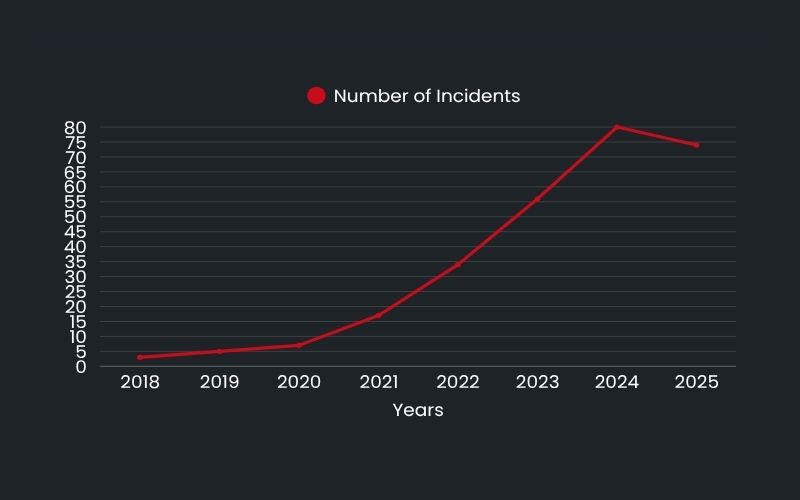
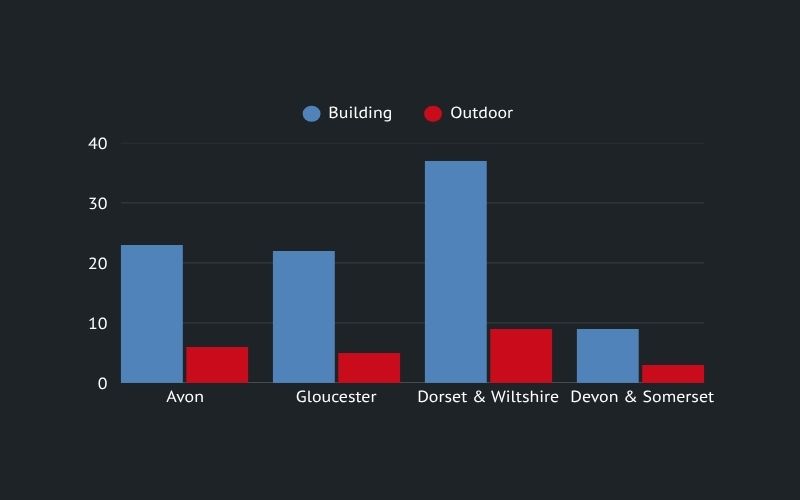
Whilst the data supports that the majority of the fires are in domestic settings, where precautionary measures will be significantly less, the data still reveals a pattern that storing or charging lithium-ion batteries incorrectly can lead to a significant risk
In one Dorset & Somerset incident, stored lithium-ion tool batteries ignited in a shed with no electrical supply present – no charger, no plug, no external trigger. The batteries self-ignited during storage alone.
Source: Dorset & Somerset Fire Service FOI Data, 2025
The above incident is a perfect example of how the risk doesn’t just lie with usage and charging of lithium-ion batteries. The correct storage is key to reduce fire risk – the wrong temperature, batteries in contact with each other, damage or degraded cells left unchecked are enough alone to result in a fire.
What Batteries and Devices are Most at Risk?
For most people with awareness of lithium-ion battery fires, their mind is most likely to think of e-bikes or e-scooters. And it is true e-bikes do account for the largest proportion of recorded incidents in the UK. However, this only represents part of a wider picture.
It is important to understand what type of devices have lithium-ion batteries and what the risks are, both in domestic and commercial settings.
| Device Type | Risk Factors |
|---|---|
E-bikes |
363 fires were recorded in the UK in 2024 which accounts for 27% of all recorded lithium-ion battery fires.
For businesses operating courier fleets, delivery services or facilities where staff bring e-bikes onto site, the risk needs to be formally assessed. |
E-scooters and mobility scooters |
156 e-scooter fires were recorded nationally in 2024; this is an increase of 32% since 2022. Mobility scooters also rose 20% in the same period.
Avon Fire Service recorded a warehouse fire caused by VOI scooter batteries in 2022 – a reminder of the workplace risks. |
Electric vehicles (EVs) |
232 EV fires were recorded in 2024 – this is up 77% since 2022, which is reflected in the increase in EV ownership over the same period.
EV vehicles are represented in any workplace setting with the increase of personal usage, as well as businesses with EV fleets and on-site charging infrastructure. |
Vapes and e-cigarettes |
Incidents rose from 89 in 2020 to 399 in 2024 – a 348% increase in just 4 years.
Even with the 2025 disposable vape ban in place, millions of vapes are still thrown away each week causing significant risk for refuse workers, bin stores and waste areas where the vapes can ignite under pressure and heat. |
Power tools and cordless equipment |
This is one of the most significantly underreported categories in workplace settings. Cordless power tools are routinely stored in toolboxes, charging bays or shelving without containment.
The incident we mentioned earlier shows the importance of the correct storage of lithium-ion batteries. |
Solar and home battery storage systems |
Solar battery incidents recorded by Avon Fire & Rescue rose from 3 in 2023 to 14 in 2025 – an increase of over 360%
As more businesses and commercial premises install rooftop solar alongside battery storage systems, this category is becoming more of a commercial concern. |
Phones, laptops and everyday devices |
1 in 9 adults in the UK have experienced a fire or explosion from a lithium-ion battery or device and 1 in 5 have had a device overheat.
Even though the risk is lower per device when compared to e-bikes, the volume in circulation is significantly higher. An overheating laptop returned by an employee, a cracked phone battery or a counterfeit USB charger are all real risk in office environments. |
Awareness of Devices Containing Lithium-ion Batteries
Research by Aviva in 2024 found that awareness of everyday devices that contain lithium-ion batteries is surprisingly low. If people do not know a device contains a lithium-ion battery, they are unlikely to treat it with the appropriate care during storage or charge.
The awareness stats based on device are:
- Mobile phones – 37% of adults
- Laptops – 33% of adults
- Power tools – 23% of adults
- Vapes – 22% of adults
- Smart home devices – 20% of adults
- Electric toothbrushes – 17% of adults
On top of this more than 7 in 10 UK adults do not know the warning signs of a lithium-ion battery that is about to fail.
Source: Aviva research, 2,002 UK adults, January 2024
Why are Lithium-Ion Battery Fires so Dangerous?
The statistics tell us the facts about how often lithium-ion battery fires happen. What they don’t necessarily convey is how different these fires are from any other kind of fire. It is this difference which is of significant importance when you consider the storage and charging of these batteries.
The account from Sky News is not an outlier, fire services, research scientists and insurance companies will all tell you the same thing: lithium-ion battery fires behave in ways that most people and workplaces are not prepared for.
The key factors that need to be understood are:
- The speed – when a lithium-ion battery enters thermal runaway the time available to respond is measured in seconds not minutes. Within 10 to 15 seconds from first visible smoke flaming combustion begins and toxic gases ignite, within 30 to 40 seconds you get a flashover and an entire room is engulfed, within minutes the fire spreads to adjacent rooms, cells or vehicles.
- The temperature – battery cells can reach temperatures exceeding 600 degrees centigrade, which is far beyond a conventional fire. Water can cool surrounding area and slow propagation but cannot extinguish electrochemical reactions in individual cells. Major EV fires have required 30,000 gallons of water to bring under control.
- The toxicity – lithium-ion battery fires also vent toxic gases including hydrogen fluoride, carbon monoxide, hydrogen cyanide and methane. All of which are dangerous in themselves in enclosed environments. The accumulation of these gases can create a flammable vapour.
- The reignition risk – this is one of the most dangerous characteristics of a lithium-ion battery fire because damaged cells can re-enter thermal runaway hours or days after the fire has initially been extinguished.
- The charging myth – it is a common assumption that batteries left plugged in overnight or charged with the wrong charge cause fires, but this is only part of the story. Fires can result because of degradation, damage or improper storage.
If you want to learn more about the correct storage and health and safety responsibilities then read our complete guide to lithium-ion battery storage.
What are the Risks to your Business?
Whilst most news stories focus on lithium-ion battery fires in home settings – because these produce the most dramatic human stories. The risks for businesses are very much real, especially considering the volumes of batteries that could be present in a commercial setting.
54% of UK businesses have experienced an incident involving a lithium-ion battery, ranging from overheating and smoking to full fires and explosions. Nearly one in five reported a fire or explosion in the workplace.
Source: Censuswide survey of 501 UK businesses, September 2024
The British Safety Council carried out a survey of more than 500 businesses between September 2023 and February 2024 and found that 71% of them had not updated their fire risk assessment to account for lithium-ion batteries.
The number of incidents combined with businesses not updating risk assessments shows that businesses aren’t reviewing risks and putting controls in place for lithium-ion battery fires. Which will then impact liability and insurance. With the risks so high, why wouldn’t your business want to ensure that they had the correct precautions in place, the investment in managing and understanding the risks would be minimal compared to what you could expect if you did have a fire.
The Role of a Battery Safe
Whilst the data is alarming, the right containment makes a significant difference.
If your business stores or charges lithium-ion batteries, then a certified battery safe is no longer optional – it is essential.
At Thornhill Security we have a range of battery safes and storage chests which include secure charging facilities. Find out more about our battery storage solutions.
If you are unsure about what you require and need further advise, please call us on 0117 967 4994 or email info@thornhillsecurityltd.co.uk.