Lithium-ion batteries are in almost everything; they not only power laptops and smartphones but also voltage tools, e-bikes, and energy storage systems. In fact, they are the most efficient and reliable tools in the market, but if they are not stored properly, they can cause a significant safety hazard.
Improper storage can result in a scenario such as a fire or a chemical leak, or the battery life can be drastically reduced. Thus, it is not only the safety of the batteries that is important, but also the protection of your battery investments, which require you to have very clear storage instructions.
Our complete guide to proper lithium-ion battery storage will explain the importance of proper lithium-ion storage, as well as guide employees and safety professionals through step-by-step guidance on the best methods of storage for businesses and individuals.
Why Proper Storage of Lithium-ion Batteries Matters
One thing about lithium-ion batteries that makes them quite amazing is the amount of power they store in a small space. Such energy can be released in the form of fire, heat, or explosion if these batteries are damaged or exposed to harsh conditions.
Over a long period, any of the following actions:
- Storing at high or low temperatures
- Leaving fully charged
- Completely discharged for an extended time
- Stacking in the wrong manner
Can wear out the battery and so increase the risk of further damage to the batteries themselves or to property. Apart from the safety issue, improper storage leads to the battery’s lifetime reduction, which, in turn, leads to replacement costs getting higher and more waste being generated.
The risk is increasing rapidly. In 2024, UK fire services attended 1,330 lithium ion battery fires, a rise of 93% in just two years. Over 1,200 fires were reported in waste and recycling sites, and more than half of UK businesses have experienced a battery related overheating or fire incident. Since 2020 there have been at least 190 injuries and 10 fatalities linked to lithium-ion battery fires.
These are not isolated accidents. They show why safe, compliant storage is now a vital part of health and safety management.
The Key Risks
A damaged or overheating battery can reach temperatures of more than 600 °C. At these temperatures one of the biggest dangers associated with lithium-ion batteries is thermal runaway. This is a process whereby the temperature of battery continues to rise on its own until eventually this results into a fire.
Other key risks are:
- Short circuits as a result of uncovered terminals and chemical leaks if the cell casing has been damaged.
- Environmental factors such as room temperature being too hot or too cold and air moisture might affect the battery and result in other threats.
- Fire and explosion: internal pressure or chemical reactions can result in battery faults, breakages and overheating which can then result in the previously mentioned thermal runaway.
- Chemical hazards: damage to batteries due to incorrect storage can result in them leaking or venting corrosive or flammable electrolytes. This would require careful handling and disposal.
- Smoke and toxic gases: combustion or overheating can produce gases that are harmful, such as hydrogen fluoride. This can cause serious respiratory hazards for anyone working near the damaged battery and environmental hazards.
- Structural and building impacts: fire or explosions from lithium-ion batteries can produce such catastrophic results, you will then have to resolve significant structural damage to buildings and infrastructure.
- Human and operational error: improper handling, charging or inadequate training can all lead to accidents or battery failure.
Knowledge of these hazards is the very first step towards having a safe storage system in place. We discuss later in our guide the importance of understanding and managing these risks, and whose responsibility it is.
Best Practices for Lithium-Ion Battery Storage
How can one really achieve the storage of lithium-ion batteries in a safe and effective manner? Try the following steps:
- Choose the right environment
Store batteries in a cool, dry and well-ventilated space. The ideal temperature is between 5 °C and 20 °C. Keep them away from direct sunlight, heaters or damp areas. - Use a certified battery safe
This is the most important distinction. Flammable liquid cabinets are tested under EN 14470-1, which protects contents from an external fire. However, lithium-ion batteries usually ignite from the inside. Once a battery enters thermal runaway, an EN 14470 cabinet cannot contain or extinguish the internal fire.
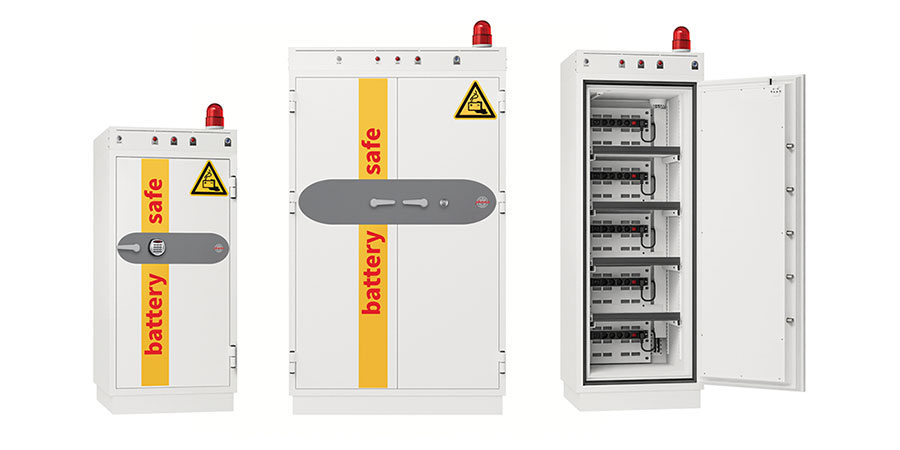
A VDMA 24994:2024-08 certified battery safe is tested the other way around. Fires are deliberately started inside the unit to prove that the safe can contain, suppress and extinguish the flames and stop heat or gases escaping.
In short:
A cabinet resists fire from the outside in. A battery safe stops fire from the inside out.
| Standard | Test Direction | Main Purpose | Result |
|---|---|---|---|
EN 14470-1 |
Outside → Inside |
Protects chemicals from external fires |
Batteries can still ignite and spread fire |
VDMA 24994 |
Inside → Outside |
Contains and extinguishes internal battery fire |
Prevents spread and suppresses gases |
- Keep batteries partially charged
It is recommended when storing your batteries to keep them between 40% to 70% charge. By avoiding leaving them fully charged or completely flat, you are extending the battery life, which as a result reduces the risk of battery failure. - Separate and secure batteries
Do not stack batteries or let them touch each other. Cover each battery’s exposed terminals with non-conductive insulating tape, such as electrical tape, to prevent any accidental contact that could cause a short circuit. This simple step is highly effective at reducing heat buildup and the chance of sparks. If storing many batteries, use separate trays or compartments within the safe to prevent contact between cells. - Inspect regularly
Check batteries for swelling, leakage or damage. Any affected battery should be isolated immediately inside a fire-resistant container and assessed by a safety professional. - Limit quantities and record holdings
Spread storage between multiple safes where possible. Keep a record of the number, type and location of batteries and note inspection dates for traceability. - Plan for emergencies
Ensure your fire plan includes scenarios involving lithium-ion batteries and that appropriate extinguishers for electrical fires are readily available. Provide staff training on what to do if a battery overheats or vents smoke.
Your Health and Safety Responsibilities
Storage of lithium-ion batteries is not only good housekeeping but also a health and safety responsibility of any business, irrespective of the size.
We spoke to one of our health and safety partners to understand the key best practices for any business to consider when they are handling and storing lithium-ion batteries.
Health and Safety Good Practices
Perform a risk assessment – This will identify any potential hazards associated with the storage, charging and handling of batteries and outline suitable control measures that can be implemented.
Control of the environment – Maintaining a stable, cool and dry environment with adequate ventilation will minimise heat build-up, prevent condensation and reduce the risk of fire.
State and storage of batteries – Storing batteries with a partial charge, between 40%-50%, protecting terminals with insulating tape and avoiding stacking them will prevent damage or short circuits.
Segregation, spacing and containment – Keeping batteries separated with adequate spacing between units and fire-resistant containers will prevent propagation if a battery fails.
Fire detection and suppression – Installing appropriate fire detection systems and ensuring access to fire extinguishers which are suitable for electrical and lithium-ion fires, such as class D or dry chemicals.
Electrical controls and safe charging and handling – Using manufacturer-approved chargers and cables, never leaving batteries unattended when charging and handling all connections carefully to avoid short circuits and overheating.
Inspection and maintenance – Inspecting batteries and storage units regularly for any signs of damage, leaking or swelling and removing all defective units for safe disposal.
Emergency planning and training – Ensuring there is an emergency response plan which covers battery fires or leaks and providing adequate training, so everyone knows how to respond safely.
Documentation, traceability and compliance – Keeping records of all battery types, quantities, location of storage, inspections and disposals to demonstrate compliance with the Health and Safety at Work Act 1974 and any other relevant regulations.
Training is one of the requirements for the staff; besides that, they would also need an emergency and fire procedure in place with the correct fire extinguishers prepositioned.
If you are unsure about your health and responsibilities, then it is always best advised to reach out to your health and safety provider. The first step would be to organise a health and safety risk assessment, you can find out more about these from our partner Sureteam.
Your Insurance Responsibilities
Insurers are now alert to the risks associated with lithium-ion storage. Many policies require the use of VDMA certified battery safes or equivalent containment. If storage relies on standard cabinets or lockers, that may not satisfy insurance or legal expectations in the event of a fire.
A single certified safe costs far less than the aftermath of one uncontrolled battery fire. Businesses have lost stock, data, buildings and insurance coverage after a single incident. Investing in proper containment reduces downtime, protects staff and helps maintain compliance with the Health and Safety at Work Act 1974 and future legislation.
If your current storage does not state VDMA 24994 certification, it is not designed for the specific hazard posed by lithium ion batteries. It may resist fire, but it cannot stop it.
Correct Disposal and Recycling
One thing that should never happen is that lithium-ion batteries should be thrown away with regular rubbish. Some of the key factors to consider when disposing of lithium-ion batteries safely are:
- They may only be disposed of through recycling or with the support of hazardous waste or battery recycling programs.
- Before transportation, terminals will be taped and batteries packed in separate bags or containers.
- Training is required for the handling of broken batteries, and this job should be left to professionals.
The Future of Lithium-Ion Battery Safety
A Lithium-Ion Battery Safety Bill has been introduced in the House of Lords that, if enacted, would make provisions for the safe storage, use and disposal of lithium ion batteries across the UK. Although the Bill is still in the early stages and has not yet become law, it signals growing political and regulatory attention on the risks posed by these batteries.
At the same time, the wider Product Safety and Metrology Bill includes provisions that could strengthen product safety and supply chain requirements for battery-powered goods. These developments indicate that future legislation is likely to move towards stricter safety expectations for storage and charging.
For that reason, organisations should act now. Upgrading to VDMA-certified safes and adopting best practice storage procedures is a proactive way to stay ahead of likely legal and insurance requirements rather than rushing to catch up later.
Forward-thinking companies are already replacing chemical storage cabinets with tested battery safes. Prevention is cheaper than recovery, and compliance is easier than catastrophe.
Thornhill’s Battery Storage Solutions
At Thornhill, we understand that storing lithium-ion safely is crucial for so many businesses. Not just for compliance and risk reduction but also for protecting your people and property. This is why we supply a specialist range of fire-resistant battery storage solutions designed for lithium-ion applications.
Our Battery Safes and Lithium-Ion Chests are engineered to prevent overheating, reduce the risk of fire propagation and provide secure containment for batteries of all sizes. For businesses that may require enhanced protection, we offer heavy-duty, constructed and fire-resistant tested safes to meet the safety standards.
Whether you are storing small tools or managing large-scale industrial stock, Thornhill can help you. Explore Thornhill’s full range of battery storage solutions, or contact our expert team for advice on the best products for your environment.